Marcelo Paiva

All criteriaPresent as slides

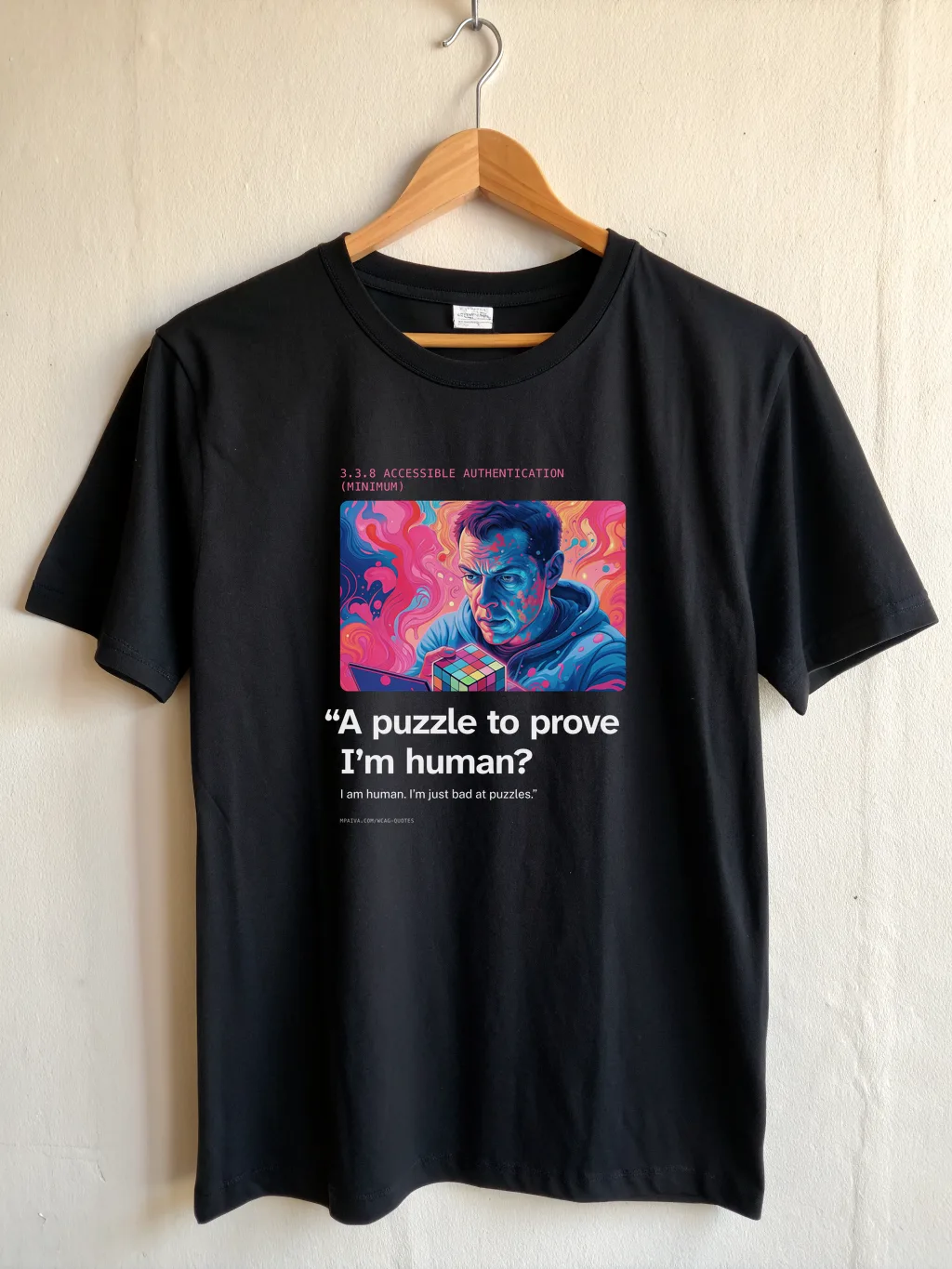
A man in a hoodie frowns at a puzzle cube in his hand, a laptop open in front of him.Meant to show: A man with a brain injury, for whom memory tests and puzzles are a locked door

Success criterion 3.3.8

Accessible Authentication (Minimum)

For any step in an authentication process, alternatives are provided that do not rely on cognitive function tests, such as remembering or solving puzzles.

  • Level AA
  • Principle 3: Understandable
  • Guideline 3.3: Input Assistance
  • New in WCAG 2.2

In a user’s words

“A puzzle to prove I'm human? I am human. I'm just bad at puzzles.”

Who this helps: Cognitive Impairments, Memory

What each role can do

Product manager
Explore and implement authentication methods that minimize cognitive load, such as biometric or device-based authentication.
Designer
Design authentication processes that are intuitive and provide alternatives to traditional memory-based passwords.
Developer
Integrate authentication alternatives that accommodate users with cognitive impairments, ensuring security without reliance on memory tests.
Tester
Test authentication processes to ensure they are accessible to users with various cognitive abilities, focusing on ease of use and security.

Once it is fixed

“No puzzle, no riddle, and I'm in. Thanks for trusting that I'm me!”

The quotes are written to illustrate the criterion. They are not testimonials from real people. For the official wording, find 3.3.8 in the W3C quick reference for WCAG 2.2 (opens in a new tab).

Or press the left arrow and the right arrow.

A success criterion

This is one page of a phrase book. It takes one success criterion and tells it from the side of the person it helps.

From top to bottom

  1. At the top, the site header: my name, which goes home, then links to Writing, Work, Signal, Tools and Resume, then Settings, where you choose the drawings, light or dark, and movement.
  2. Links back to all the criteria, and to present this one as slides.
  3. A drawing, the criterion’s number and name, what it requires in one sentence, and its level.
  4. In a user’s words: a quote from the person who meets the barrier.
  5. What each role can do: one task each for the product manager, the designer, the developer and the tester.
  6. Once it is fixed: the same person again.
  7. Share this with your team: post to LinkedIn, download the slides as a PDF, or copy a link.
  8. Some criteria then have a t-shirt to order.
  9. Links to the previous and next criterion. The left and right arrow keys go there too.
  10. At the bottom, the footer: a note on how this site is built, links to Illustrations, Pens, Concepts and Accessibility, this Describe this page button, then GitHub, LinkedIn and email.

What you can do here

Learn what this criterion asks, and what your part of the fix is.

Also here

The quotes are written to illustrate the criterion. They are not from real people.